Yachts For Sale
Yacht for sale
Yachts For Sale
Content
They Modernised Her Without Erasing Her History | Inside KORU
The Extraordinary Story Behind AZTECA
To understand KORU, you really need to go back to the beginning. She was originally commissioned as AZTECA by Mexican media businessman Emilio Azcárraga and was one of a pair of near-identical Feadships built in tandem, AZTECA and PARAISO.
It was an unusual project even by Feadship standards. The two yachts were constructed at different Feadship yards, one at De Vries and the other at Van Lent, with the intention of creating yachts that were remarkably similar. Feadship's own history records that Azcárraga originally had ambitions for an even larger series, but the shipyard wasn't prepared to commit so much of its future production capacity to one project.
The yachts became known locally as the “greenhouse” yachts, a reference to the enormous amount of glass incorporated into their upper decks. That might not sound particularly remarkable today, when floor-to-ceiling windows have become almost expected on a large yacht, but this was 1983. At the time, the amount of glass and the geometry of the design made AZTECA look very different from the yachts around her.

The Extraordinary Story Behind AZTECA
To understand KORU, you really need to go back to the beginning. She was originally commissioned as AZTECA by Mexican media businessman Emilio Azcárraga and was one of a pair of near-identical Feadships built in tandem, AZTECA and PARAISO.
It was an unusual project even by Feadship standards. The two yachts were constructed at different Feadship yards, one at De Vries and the other at Van Lent, with the intention of creating yachts that were remarkably similar. Feadship's own history records that Azcárraga originally had ambitions for an even larger series, but the shipyard wasn't prepared to commit so much of its future production capacity to one project.
The yachts became known locally as the “greenhouse” yachts, a reference to the enormous amount of glass incorporated into their upper decks. That might not sound particularly remarkable today, when floor-to-ceiling windows have become almost expected on a large yacht, but this was 1983. At the time, the amount of glass and the geometry of the design made AZTECA look very different from the yachts around her.
The Extraordinary Story Behind AZTECA
To understand KORU, you really need to go back to the beginning. She was originally commissioned as AZTECA by Mexican media businessman Emilio Azcárraga and was one of a pair of near-identical Feadships built in tandem, AZTECA and PARAISO.
It was an unusual project even by Feadship standards. The two yachts were constructed at different Feadship yards, one at De Vries and the other at Van Lent, with the intention of creating yachts that were remarkably similar. Feadship's own history records that Azcárraga originally had ambitions for an even larger series, but the shipyard wasn't prepared to commit so much of its future production capacity to one project.
The yachts became known locally as the “greenhouse” yachts, a reference to the enormous amount of glass incorporated into their upper decks. That might not sound particularly remarkable today, when floor-to-ceiling windows have become almost expected on a large yacht, but this was 1983. At the time, the amount of glass and the geometry of the design made AZTECA look very different from the yachts around her.
When Jon Bannenberg Was Rewriting the Rules
Jon Bannenberg is such an important part of this story because KORU wasn't simply another yacht from his studio.
The original AZTECA had the angular forms, strong geometry and unconventional proportions that made Bannenberg's work immediately recognisable. Even by his standards, she was unusual. The large expanses of glass, stepped profile and almost architectural exterior gave the yacht a character that was difficult to confuse with anything else being built at the time.
There is a wonderful detail in Feadship's history of the project. Malcolm Forbes apparently saw AZTECA and was so impressed that he wanted a yacht like her. That gives some idea of the impact the design had when she appeared.
This is also why Katia was particularly interested in filming KORU. She is a serious Bannenberg enthusiast, and the yacht's history meant that this wasn't simply another 50-metre yacht walkthrough. There was a genuine question about how much of that original character had survived.

When Jon Bannenberg Was Rewriting the Rules
Jon Bannenberg is such an important part of this story because KORU wasn't simply another yacht from his studio.
The original AZTECA had the angular forms, strong geometry and unconventional proportions that made Bannenberg's work immediately recognisable. Even by his standards, she was unusual. The large expanses of glass, stepped profile and almost architectural exterior gave the yacht a character that was difficult to confuse with anything else being built at the time.
There is a wonderful detail in Feadship's history of the project. Malcolm Forbes apparently saw AZTECA and was so impressed that he wanted a yacht like her. That gives some idea of the impact the design had when she appeared.
This is also why Katia was particularly interested in filming KORU. She is a serious Bannenberg enthusiast, and the yacht's history meant that this wasn't simply another 50-metre yacht walkthrough. There was a genuine question about how much of that original character had survived.
When Jon Bannenberg Was Rewriting the Rules
Jon Bannenberg is such an important part of this story because KORU wasn't simply another yacht from his studio.
The original AZTECA had the angular forms, strong geometry and unconventional proportions that made Bannenberg's work immediately recognisable. Even by his standards, she was unusual. The large expanses of glass, stepped profile and almost architectural exterior gave the yacht a character that was difficult to confuse with anything else being built at the time.
There is a wonderful detail in Feadship's history of the project. Malcolm Forbes apparently saw AZTECA and was so impressed that he wanted a yacht like her. That gives some idea of the impact the design had when she appeared.
This is also why Katia was particularly interested in filming KORU. She is a serious Bannenberg enthusiast, and the yacht's history meant that this wasn't simply another 50-metre yacht walkthrough. There was a genuine question about how much of that original character had survived.
Forty Years Later, a Very Different Yacht
A yacht doesn't remain relevant for more than four decades without changing.
During her life, KORU has carried several names, including AZTECA, MI ALICIA and LIONWIND, and has been modified more than once. But the most significant transformation came with the extensive two-year rebuild completed in 2024.
This went far beyond the sort of refit where interiors are refreshed and technical equipment is replaced. The yacht's exterior appearance changed substantially, her interior was redesigned and her machinery and systems received extensive attention.
Most significantly, the stern was extended by 3.2 metres, bringing KORU to her present overall length of 49.89 metres and allowing the entire relationship between the yacht and the water to be reconsidered.
For Katia, this was also where things became slightly complicated. As somebody who admires the original Bannenberg design, she admitted that she was nervous before seeing the yacht. When a yacht has genuine historical design significance, there is always an argument for preserving as much as possible. But there is another argument too: yachts are built to be used.

Forty Years Later, a Very Different Yacht
A yacht doesn't remain relevant for more than four decades without changing.
During her life, KORU has carried several names, including AZTECA, MI ALICIA and LIONWIND, and has been modified more than once. But the most significant transformation came with the extensive two-year rebuild completed in 2024.
This went far beyond the sort of refit where interiors are refreshed and technical equipment is replaced. The yacht's exterior appearance changed substantially, her interior was redesigned and her machinery and systems received extensive attention.
Most significantly, the stern was extended by 3.2 metres, bringing KORU to her present overall length of 49.89 metres and allowing the entire relationship between the yacht and the water to be reconsidered.
For Katia, this was also where things became slightly complicated. As somebody who admires the original Bannenberg design, she admitted that she was nervous before seeing the yacht. When a yacht has genuine historical design significance, there is always an argument for preserving as much as possible. But there is another argument too: yachts are built to be used.
Forty Years Later, a Very Different Yacht
A yacht doesn't remain relevant for more than four decades without changing.
During her life, KORU has carried several names, including AZTECA, MI ALICIA and LIONWIND, and has been modified more than once. But the most significant transformation came with the extensive two-year rebuild completed in 2024.
This went far beyond the sort of refit where interiors are refreshed and technical equipment is replaced. The yacht's exterior appearance changed substantially, her interior was redesigned and her machinery and systems received extensive attention.
Most significantly, the stern was extended by 3.2 metres, bringing KORU to her present overall length of 49.89 metres and allowing the entire relationship between the yacht and the water to be reconsidered.
For Katia, this was also where things became slightly complicated. As somebody who admires the original Bannenberg design, she admitted that she was nervous before seeing the yacht. When a yacht has genuine historical design significance, there is always an argument for preserving as much as possible. But there is another argument too: yachts are built to be used.
The Stern Tells You What Has Changed
Perhaps the clearest example of that philosophy is at the stern.
The 3.2-metre extension created a much larger swim platform and beach club, giving guests the sort of connection with the water that simply wasn't part of yacht design thinking when AZTECA was launched.
The transformation continues higher up. A completely new sundeck was created with a Jacuzzi, bar, dining and lounging areas, together with the possibility of an outdoor cinema setup.
None of this would have appeared on the original yacht in this form. In 1983, owners used their yachts differently and designers were solving different problems. Today, exterior living, direct access to the sea and multiple informal social spaces have become central to the way many owners use their yachts.
So the changes are substantial. The interesting thing is that Katia came away feeling that the rebuild had been sympathetic to the yacht rather than simply erasing what had come before. That is a difficult balance to achieve on any classic yacht, particularly one associated with a designer as important as Bannenberg.
The Stern Tells You What Has Changed
Perhaps the clearest example of that philosophy is at the stern.
The 3.2-metre extension created a much larger swim platform and beach club, giving guests the sort of connection with the water that simply wasn't part of yacht design thinking when AZTECA was launched.
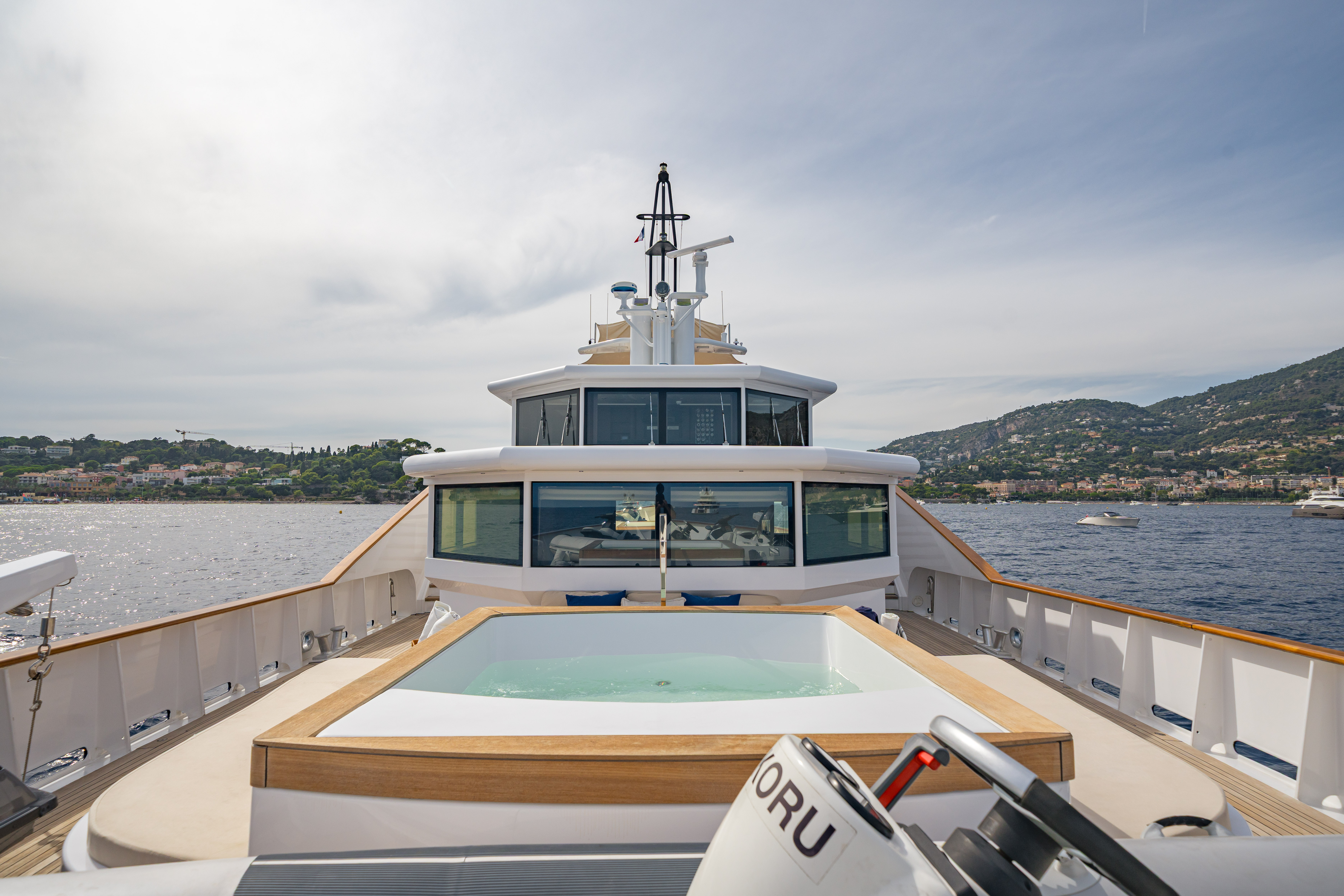
The transformation continues higher up. A completely new sundeck was created with a Jacuzzi, bar, dining and lounging areas, together with the possibility of an outdoor cinema setup.
None of this would have appeared on the original yacht in this form. In 1983, owners used their yachts differently and designers were solving different problems. Today, exterior living, direct access to the sea and multiple informal social spaces have become central to the way many owners use their yachts.
So the changes are substantial. The interesting thing is that Katia came away feeling that the rebuild had been sympathetic to the yacht rather than simply erasing what had come before. That is a difficult balance to achieve on any classic yacht, particularly one associated with a designer as important as Bannenberg.
The Stern Tells You What Has Changed
Perhaps the clearest example of that philosophy is at the stern.
The 3.2-metre extension created a much larger swim platform and beach club, giving guests the sort of connection with the water that simply wasn't part of yacht design thinking when AZTECA was launched.
The transformation continues higher up. A completely new sundeck was created with a Jacuzzi, bar, dining and lounging areas, together with the possibility of an outdoor cinema setup.
None of this would have appeared on the original yacht in this form. In 1983, owners used their yachts differently and designers were solving different problems. Today, exterior living, direct access to the sea and multiple informal social spaces have become central to the way many owners use their yachts.
So the changes are substantial. The interesting thing is that Katia came away feeling that the rebuild had been sympathetic to the yacht rather than simply erasing what had come before. That is a difficult balance to achieve on any classic yacht, particularly one associated with a designer as important as Bannenberg.
Five Staterooms and a New Way of Living On Board
The transformation continues inside.
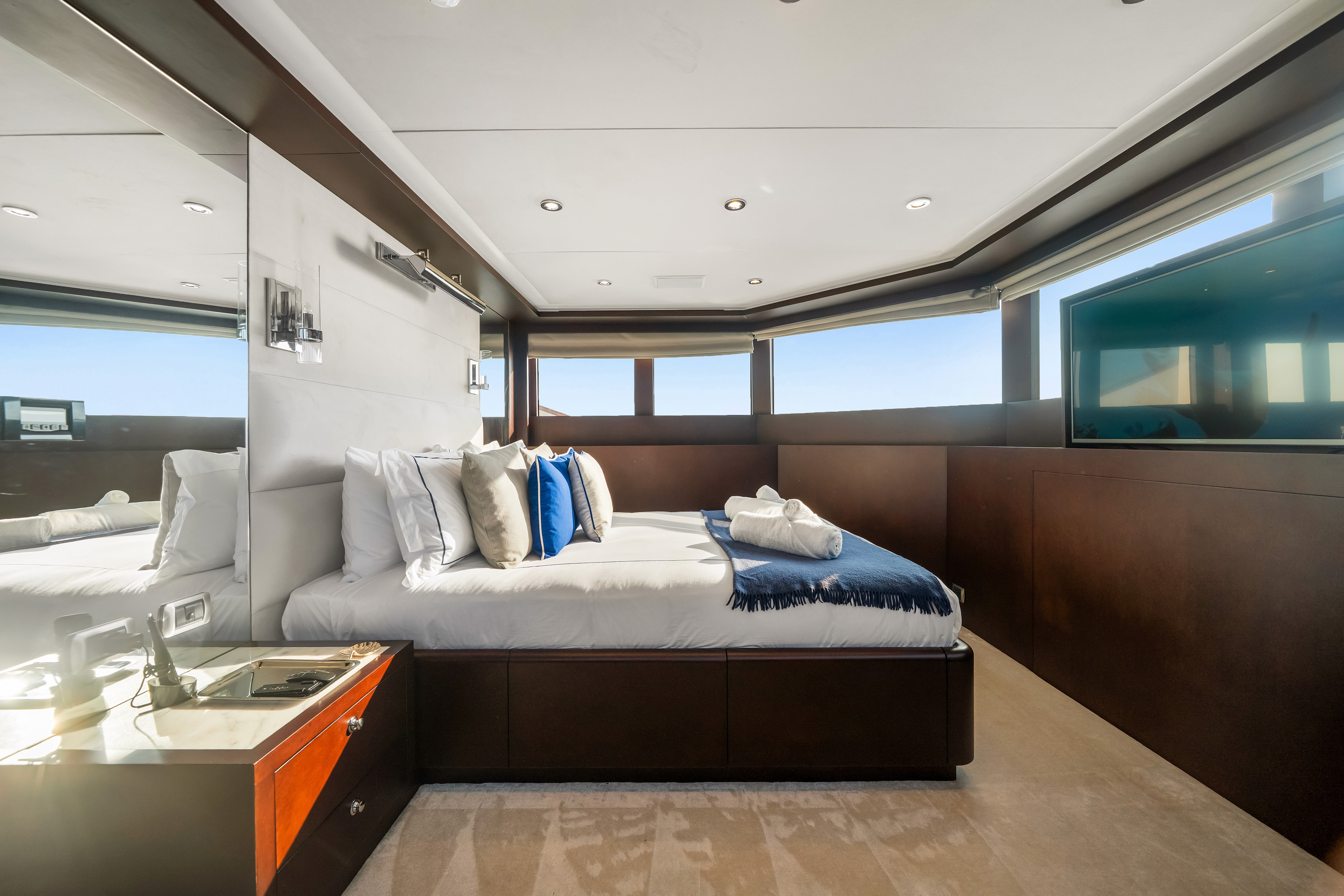
KORU now accommodates ten guests in five staterooms. The full-beam master suite is located on the lower deck, together with additional guest accommodation, while a VIP stateroom is positioned forward on the main deck.
During the rebuild, a former television lounge was converted into the fifth guest stateroom, another example of the yacht being adapted to the expectations of a modern owner.
That distinction matters. Preserving a yacht doesn't necessarily mean freezing her in time. An owner buying a yacht today expects a certain level of privacy, connectivity, accommodation and functionality, regardless of when the hull was originally launched.
KORU's interior therefore isn't attempting to recreate 1983. Instead, the rebuild has created a yacht that can function as a contemporary 50-metre superyacht while retaining the pedigree of the original Feadship beneath it.
And with 435 GT, there is enough volume to provide substantial guest spaces without trying to turn KORU into something she was never intended to be.
Five Staterooms and a New Way of Living On Board
The transformation continues inside.
KORU now accommodates ten guests in five staterooms. The full-beam master suite is located on the lower deck, together with additional guest accommodation, while a VIP stateroom is positioned forward on the main deck.
During the rebuild, a former television lounge was converted into the fifth guest stateroom, another example of the yacht being adapted to the expectations of a modern owner.
That distinction matters. Preserving a yacht doesn't necessarily mean freezing her in time. An owner buying a yacht today expects a certain level of privacy, connectivity, accommodation and functionality, regardless of when the hull was originally launched.
KORU's interior therefore isn't attempting to recreate 1983. Instead, the rebuild has created a yacht that can function as a contemporary 50-metre superyacht while retaining the pedigree of the original Feadship beneath it.
And with 435 GT, there is enough volume to provide substantial guest spaces without trying to turn KORU into something she was never intended to be.
Five Staterooms and a New Way of Living On Board
The transformation continues inside.
KORU now accommodates ten guests in five staterooms. The full-beam master suite is located on the lower deck, together with additional guest accommodation, while a VIP stateroom is positioned forward on the main deck.
During the rebuild, a former television lounge was converted into the fifth guest stateroom, another example of the yacht being adapted to the expectations of a modern owner.
That distinction matters. Preserving a yacht doesn't necessarily mean freezing her in time. An owner buying a yacht today expects a certain level of privacy, connectivity, accommodation and functionality, regardless of when the hull was originally launched.
KORU's interior therefore isn't attempting to recreate 1983. Instead, the rebuild has created a yacht that can function as a contemporary 50-metre superyacht while retaining the pedigree of the original Feadship beneath it.
And with 435 GT, there is enough volume to provide substantial guest spaces without trying to turn KORU into something she was never intended to be.
The Numbers Behind KORU
The current specifications help put the yacht into perspective.
KORU measures 49.89 metres, with a beam of 8.41 metres, a draft of 2.49 metres and an internal volume of 435 GT. She is built entirely in aluminium on a semi-displacement hull, with naval architecture by De Voogt.
That aluminium construction is an important part of her original character. KORU came from a period when Feadship and Bannenberg were prepared to experiment with both engineering and design to achieve something different.
Her machinery has also received extensive attention during the rebuild. KORU is powered by twin MTU 16V538 engines, and Northrop & Johnson's current listing gives a cruising speed of 18 knots and maximum speed of 20 knots.
She carries 50,000 litres of fuel and 12,000 litres of fresh water, while modern systems now include Starlink, updated navigation equipment, stabilisation and a bow thruster.
So although the history dates back more than 40 years, the yacht has been equipped to operate in a very different world.

The Numbers Behind KORU
The current specifications help put the yacht into perspective.
KORU measures 49.89 metres, with a beam of 8.41 metres, a draft of 2.49 metres and an internal volume of 435 GT. She is built entirely in aluminium on a semi-displacement hull, with naval architecture by De Voogt.
That aluminium construction is an important part of her original character. KORU came from a period when Feadship and Bannenberg were prepared to experiment with both engineering and design to achieve something different.
Her machinery has also received extensive attention during the rebuild. KORU is powered by twin MTU 16V538 engines, and Northrop & Johnson's current listing gives a cruising speed of 18 knots and maximum speed of 20 knots.
She carries 50,000 litres of fuel and 12,000 litres of fresh water, while modern systems now include Starlink, updated navigation equipment, stabilisation and a bow thruster.
So although the history dates back more than 40 years, the yacht has been equipped to operate in a very different world.
The Numbers Behind KORU
The current specifications help put the yacht into perspective.
KORU measures 49.89 metres, with a beam of 8.41 metres, a draft of 2.49 metres and an internal volume of 435 GT. She is built entirely in aluminium on a semi-displacement hull, with naval architecture by De Voogt.
That aluminium construction is an important part of her original character. KORU came from a period when Feadship and Bannenberg were prepared to experiment with both engineering and design to achieve something different.
Her machinery has also received extensive attention during the rebuild. KORU is powered by twin MTU 16V538 engines, and Northrop & Johnson's current listing gives a cruising speed of 18 knots and maximum speed of 20 knots.
She carries 50,000 litres of fuel and 12,000 litres of fresh water, while modern systems now include Starlink, updated navigation equipment, stabilisation and a bow thruster.
So although the history dates back more than 40 years, the yacht has been equipped to operate in a very different world.
Why the Rebuild Matters as Much as the Original Build
It is easy to become distracted by the romance of an older Feadship, particularly one designed by Jon Bannenberg. But anybody considering buying a yacht of this age needs to look beyond the name of the shipyard and the designer.
The condition of the structure, machinery, systems and engineering becomes enormously important.
That is why the scale of KORU's recent rebuild matters. It lasted approximately two years and addressed the yacht far more comprehensively than a cosmetic refit would have done. The machinery and technical systems were extensively serviced and upgraded, while the accommodation, exterior spaces and guest experience were substantially reworked.
Modern connectivity and navigation equipment were incorporated, the stern was reconstructed and a new sundeck added.
This is what gives KORU an unusual position in today's brokerage market. She isn't being presented as an untouched museum piece from 1983, but neither is she simply another recently built 50-metre yacht. The platform, pedigree and history are old. Much of what makes her practical to own and use today is considerably newer.

Why the Rebuild Matters as Much as the Original Build
It is easy to become distracted by the romance of an older Feadship, particularly one designed by Jon Bannenberg. But anybody considering buying a yacht of this age needs to look beyond the name of the shipyard and the designer.
The condition of the structure, machinery, systems and engineering becomes enormously important.
That is why the scale of KORU's recent rebuild matters. It lasted approximately two years and addressed the yacht far more comprehensively than a cosmetic refit would have done. The machinery and technical systems were extensively serviced and upgraded, while the accommodation, exterior spaces and guest experience were substantially reworked.
Modern connectivity and navigation equipment were incorporated, the stern was reconstructed and a new sundeck added.
This is what gives KORU an unusual position in today's brokerage market. She isn't being presented as an untouched museum piece from 1983, but neither is she simply another recently built 50-metre yacht. The platform, pedigree and history are old. Much of what makes her practical to own and use today is considerably newer.
Why the Rebuild Matters as Much as the Original Build
It is easy to become distracted by the romance of an older Feadship, particularly one designed by Jon Bannenberg. But anybody considering buying a yacht of this age needs to look beyond the name of the shipyard and the designer.
The condition of the structure, machinery, systems and engineering becomes enormously important.
That is why the scale of KORU's recent rebuild matters. It lasted approximately two years and addressed the yacht far more comprehensively than a cosmetic refit would have done. The machinery and technical systems were extensively serviced and upgraded, while the accommodation, exterior spaces and guest experience were substantially reworked.
Modern connectivity and navigation equipment were incorporated, the stern was reconstructed and a new sundeck added.
This is what gives KORU an unusual position in today's brokerage market. She isn't being presented as an untouched museum piece from 1983, but neither is she simply another recently built 50-metre yacht. The platform, pedigree and history are old. Much of what makes her practical to own and use today is considerably newer.
How Much Should You Change a Classic?
And perhaps this is the most interesting question KORU raises.
If you own an important classic yacht, at what point does preservation stop making sense?
There will inevitably be people who look at photographs of the original AZTECA and prefer the purity of Bannenberg's 1983 design. There will be others who argue that there is little point preserving every detail of a yacht if doing so makes her less enjoyable to own and use.
KORU has clearly taken the second approach.
Her stern is different. Her sundeck is new. Her interior has evolved and the way guests interact with the sea bears little resemblance to the experience her first owner would have had more than 40 years ago.
And yet, beneath all of those changes is still a Feadship conceived during one of the most interesting periods in modern yacht design.
That was ultimately what changed Katia's mind when she went on board. She had been concerned that too much of the yacht she admired might have disappeared. Instead, she found a yacht that had been allowed to evolve.
Perhaps that is the real achievement of KORU. She doesn't pretend that it is still 1983. She takes an important piece of Feadship and Bannenberg history and asks whether it can have another life more than four decades later.
Judging by the yacht that has emerged from the rebuild, the answer is certainly an interesting one.

How Much Should You Change a Classic?
And perhaps this is the most interesting question KORU raises.
If you own an important classic yacht, at what point does preservation stop making sense?
There will inevitably be people who look at photographs of the original AZTECA and prefer the purity of Bannenberg's 1983 design. There will be others who argue that there is little point preserving every detail of a yacht if doing so makes her less enjoyable to own and use.
KORU has clearly taken the second approach.
Her stern is different. Her sundeck is new. Her interior has evolved and the way guests interact with the sea bears little resemblance to the experience her first owner would have had more than 40 years ago.
And yet, beneath all of those changes is still a Feadship conceived during one of the most interesting periods in modern yacht design.
That was ultimately what changed Katia's mind when she went on board. She had been concerned that too much of the yacht she admired might have disappeared. Instead, she found a yacht that had been allowed to evolve.
Perhaps that is the real achievement of KORU. She doesn't pretend that it is still 1983. She takes an important piece of Feadship and Bannenberg history and asks whether it can have another life more than four decades later.
Judging by the yacht that has emerged from the rebuild, the answer is certainly an interesting one.
How Much Should You Change a Classic?
And perhaps this is the most interesting question KORU raises.
If you own an important classic yacht, at what point does preservation stop making sense?
There will inevitably be people who look at photographs of the original AZTECA and prefer the purity of Bannenberg's 1983 design. There will be others who argue that there is little point preserving every detail of a yacht if doing so makes her less enjoyable to own and use.
KORU has clearly taken the second approach.
Her stern is different. Her sundeck is new. Her interior has evolved and the way guests interact with the sea bears little resemblance to the experience her first owner would have had more than 40 years ago.
And yet, beneath all of those changes is still a Feadship conceived during one of the most interesting periods in modern yacht design.
That was ultimately what changed Katia's mind when she went on board. She had been concerned that too much of the yacht she admired might have disappeared. Instead, she found a yacht that had been allowed to evolve.
Perhaps that is the real achievement of KORU. She doesn't pretend that it is still 1983. She takes an important piece of Feadship and Bannenberg history and asks whether it can have another life more than four decades later.
Judging by the yacht that has emerged from the rebuild, the answer is certainly an interesting one.